What if you could turn any document, repository, website, video transcript, or knowledge base into an intelligent AI assistant in minutes?
That is the idea behind AgentBook by Autonomyx — a practical, no-code way to build AI-powered knowledge agents using AnythingLLM.
In a world where businesses are drowning in documents, links, PDFs, internal wikis, GitHub repositories, and scattered knowledge, AgentBook offers a simple promise:
Chat with anything. Build agents from anything. Deploy knowledge without complexity.
What Is AgentBook?
AgentBook is a zero-cost AI knowledge system built around the idea of Retrieval-Augmented Generation, or RAG.
Instead of relying only on a general-purpose AI model, AgentBook lets users connect their own data sources and ask questions directly against that information. This means your chatbot or agent can respond using your actual documents, repositories, transcripts, and knowledge bases.
The result is a smarter assistant that understands your context.
It is not just a chatbot. It is a lightweight agent builder that can help teams create useful AI assistants for research, support, documentation, onboarding, development, and internal operations.
Powered by AnythingLLM
At the heart of AgentBook is AnythingLLM, a flexible platform designed to help users create private AI workspaces with their own data.
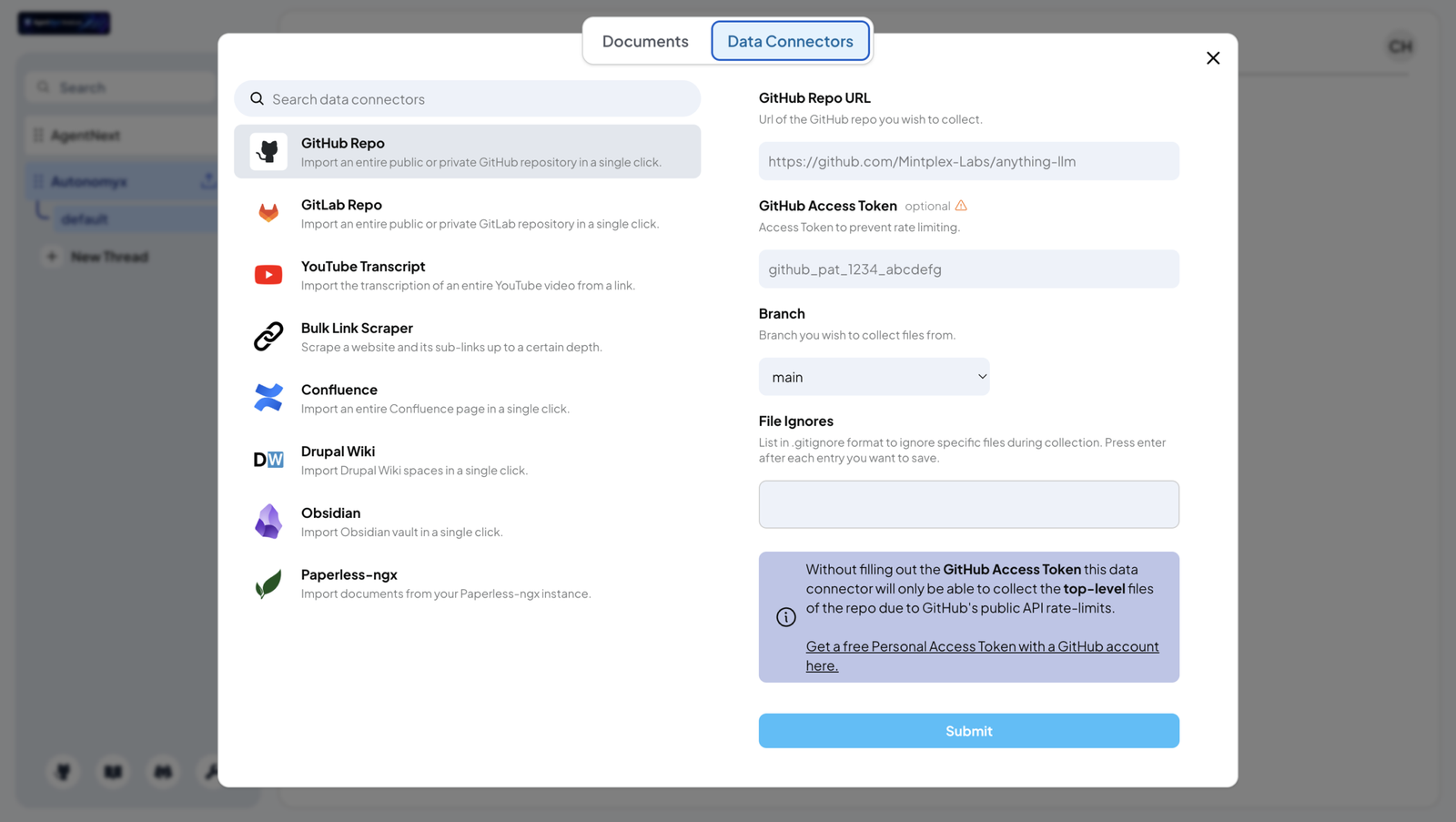
The screenshot shows a clean data connector interface where users can import content from sources such as:
- GitHub repositories
- GitLab repositories
- YouTube transcripts
- Websites through bulk link scraping
- Confluence pages
- Drupal Wiki spaces
- Obsidian vaults
- Paperless-ngx document stores
This makes AgentBook especially useful for teams that already have information spread across multiple platforms.
Instead of manually copying content into a chatbot, users can connect the source, index the data, and begin asking questions.
Why RAG Matters
Traditional chatbots are limited by what they were trained on. They may not know your company policies, your latest codebase, your product roadmap, or your internal documentation.
RAG changes that.
With Retrieval-Augmented Generation, the system first searches your connected knowledge base, finds the most relevant information, and then uses an AI model to generate a useful answer.
This makes answers more grounded, more specific, and more useful.
For example, a developer could connect a GitHub repository and ask:
“What does this function do?”
A support team could connect product documentation and ask:
“How should we respond to this customer issue?”
A founder could upload strategy documents and ask:
“What are our strongest product positioning points?”
AgentBook turns static information into a conversational knowledge layer.
Zero Cost, Maximum Utility
One of the strongest parts of AgentBook is its zero-cost positioning.
Many AI agent platforms quickly become expensive once you add document ingestion, vector search, user seats, automation, and integrations. AgentBook lowers the barrier by giving users a practical way to experiment with RAG and AI agents without heavy infrastructure costs.
This makes it ideal for:
Startups that want to test AI workflows before committing to enterprise tools.
Students and researchers who want to chat with large volumes of material.
Developers who want a private assistant for repositories and technical documentation.
Small teams that need internal knowledge search without building a custom system from scratch.
From Chatbot to Agent Builder
The phrase “chat with anything” captures the basic experience, but AgentBook can go beyond simple Q&A.
Once your knowledge sources are connected, you can start shaping agents for specific tasks.
A documentation agent can answer questions from technical docs.
A codebase agent can explain repositories and help new developers onboard.
A research agent can summarize videos, papers, and web pages.
A company knowledge agent can help employees find policies, processes, and internal answers.
This is where AgentBook becomes more than a chatbot. It becomes a framework for building focused AI assistants around real knowledge.
A Simple Workflow
The process is straightforward:
First, choose a data connector.
Then, add your source, such as a GitHub repository URL, website, transcript, or document base.
Next, let the system collect and index the content.
Finally, open a chat and start asking questions.
For GitHub repositories, users can even specify a branch and optionally provide an access token to avoid public API rate limits. This makes it useful for both public and private technical projects.
Why Autonomyx Built AgentBook
Autonomyx is focused on making AI automation more accessible. AgentBook fits that mission by removing the complexity around AI agents.
Many people hear terms like “RAG,” “vector database,” “embedding model,” and “agent workflow” and immediately assume they need a technical team to get started.
AgentBook simplifies that experience.
It gives users a practical interface where they can connect data, create a knowledge base, and interact with it naturally.
The real value is not just in the technology. It is in making the technology usable.
Use Cases for AgentBook
AgentBook can support a wide range of practical workflows.
For developers, it can act as a repository assistant that explains architecture, files, and implementation details.
For product teams, it can become a product knowledge bot trained on specs, roadmaps, and user research.
For support teams, it can answer customer questions using official documentation.
For educators, it can help students chat with course notes, lectures, and reading materials.
For businesses, it can become an internal knowledge assistant connected to company wikis and documents.
In each case, the goal is the same: reduce time spent searching and increase time spent acting.
The Future of Knowledge Work
The next generation of productivity tools will not just store information. They will understand it, retrieve it, summarize it, and help people take action.
AgentBook points toward that future.
By combining zero-cost RAG, chatbot functionality, and agent-building capabilities, Autonomyx is making it easier for anyone to build useful AI systems around their own data.
The best part is that users do not need to start with a massive AI strategy. They can start with one repository, one documentation site, one transcript, or one folder of files.
Connect it. Chat with it. Build from it.
That is the promise of AgentBook.
Final Thoughts
AgentBook by Autonomyx is a practical step toward democratizing AI agents.
It gives individuals and teams a way to transform everyday knowledge sources into conversational assistants without complex setup or high costs.
Whether you are working with code, documents, videos, websites, or internal knowledge bases, AgentBook helps you move from passive information to active intelligence.
In simple words:
AgentBook lets you chat with anything — and build agents from everything.
Leave a Reply