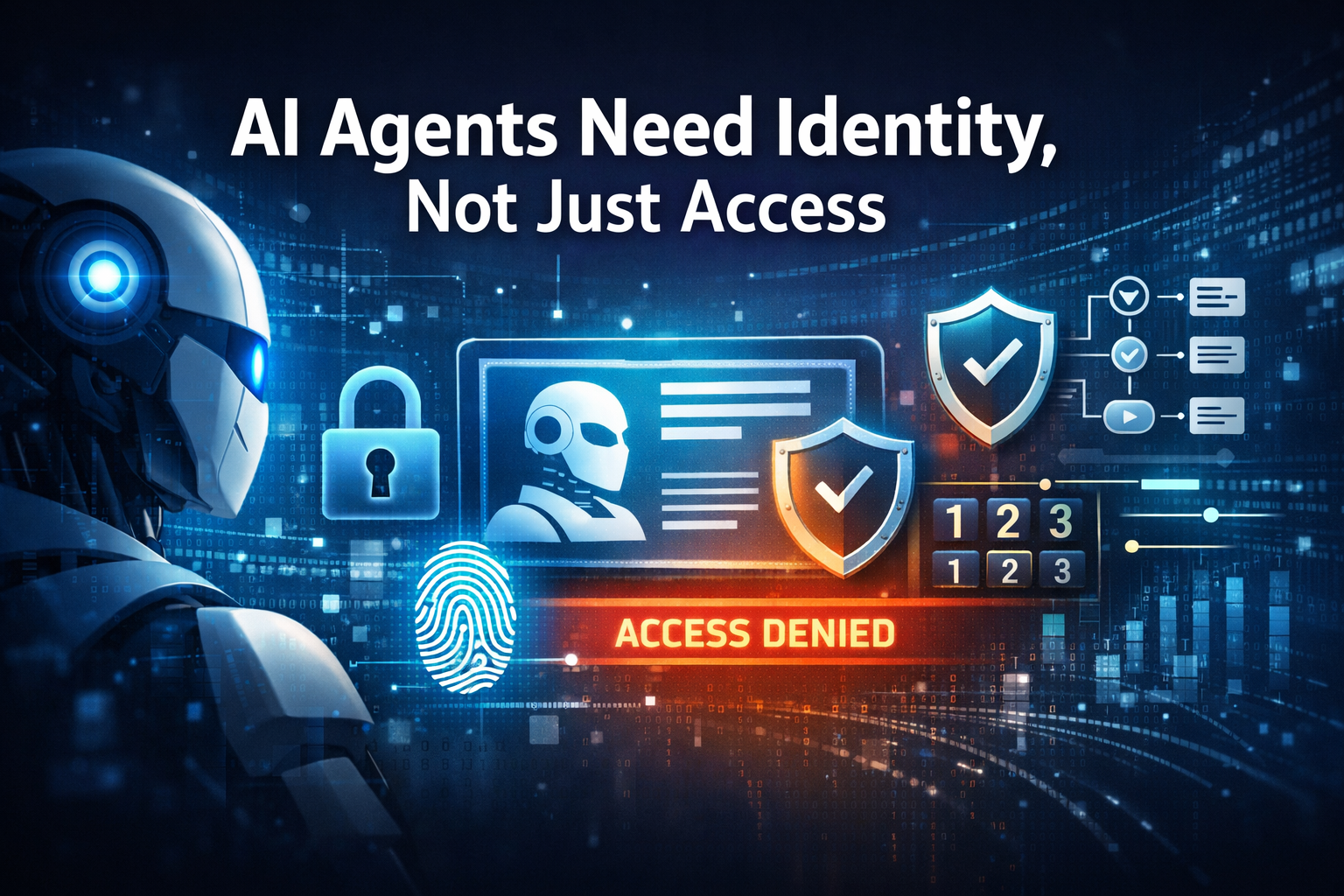
A Vendor Neutral Standard For Agent Identity & Authentication
AI agents are quickly moving from experimentation to execution.
They can call APIs, access enterprise systems, retrieve documents, trigger workflows, spend money, and increasingly act with a level of autonomy that makes them feel less like software features and more like digital operators. That shift creates a new question for every platform, security team, and builder:
Who is this agent, really?
For years, identity systems have done a good job managing two categories of actors: human users and software services. But AI agents do not fit neatly into either group. They are not employees. They are not just backend daemons. And they are not well served by being squeezed into models originally designed for apps, service accounts, or machine clients.
That is why we are introducing the Autonomyx Agent Identity Model — a governance-oriented approach for treating AI agents as managed operational principals.
Our goal is straightforward: help organizations represent, govern, and control AI agents with the same seriousness they already apply to workforce and service identities.
Why agent identity matters now
As teams begin building and deploying more AI agents, one pattern is becoming clear: visibility is not enough.
Organizations need to know:
- who created an agent
- who is accountable for it
- what models it can access
- what tools and data it can use
- how long it should exist
- what it is costing
- what it actually did
Today, many agents are still being modeled as application credentials, API keys, or generic service accounts. That approach may work for prototypes, but it breaks down fast in enterprise environments.
AI agents are often:
- created dynamically, not provisioned once by administrators
- ephemeral, not long-lived
- scoped to specific models, budgets, and capabilities
- expected to act under policy constraints
- required to be auditable and attributable
When these properties are ignored, organizations end up with what can only be described as agent sprawl: powerful non-human actors with unclear accountability and weak governance.
The idea behind Autonomyx Agent Identity
Autonomyx Agent Identity starts with a simple belief:
AI agents should be treated as governed operational principals, not merely as users without passwords or apps with better marketing.
That means an agent identity should include more than a token. It should include governance semantics.
At a minimum, every agent should have:
- a stable identity
- an accountable sponsor
- explicit access boundaries
- lifecycle state
- policy context
- audit traceability
In our model, agents are not just authenticated. They are registered, scoped, monitored, governed, and revocable.
What makes an AI agent different from a service account
Traditional service identity works well for background workloads. But AI agents introduce a different operational shape.
A service account usually represents software that was provisioned deliberately, stays relatively stable, and operates under fixed machine permissions.
An AI agent is often different. It may be created by a business user, deployed on demand, run for one task, and be allowed to use only one model, one toolchain, and one budget envelope. It may need to expire automatically. It may need to be suspended when its sponsor leaves the organization. It may need to route locally for sensitive prompts and use the cloud for general tasks.
These are not edge cases. They are increasingly the default.
That is why Autonomyx treats the agent as a distinct governance subject.
Accountable sponsorship by design
One of the most important ideas in the model is accountable sponsorship.
Every agent should be tied to a sponsor subject at creation time. In many environments, that will be a human. In others, it may be a governed team or platform-owned system principal. The key requirement is accountability, not ambiguity.
Why does that matter?
Because sooner or later every enterprise asks the same questions:
- Who approved this agent?
- Who owns it?
- Who answers for it?
- Why was it allowed to access this system?
Those answers should never depend on reverse-engineering logs from an API key.
They should be built into the model from the start.
Least privilege for models, tools, and data
Another core principle of the Autonomyx model is least privilege by default.
Agents start with no implicit access.
They should receive explicit access only to the models, tools, tenants, and data domains they actually need. A tenant may have access to 20 models, but that does not mean every agent should inherit all 20.
This is important for three reasons:
Security
Broader access means broader blast radius.
Cost control
Model access is also spend access.
Governance
Explicit scope makes policy understandable, enforceable, and auditable.
In practice, this means model access becomes a first-class part of identity governance.
Lifecycle should be part of identity, not an afterthought
AI agents are not all meant to live forever.
Some are long-lived workflow agents. Others exist only for a task, a session, or a temporary operational need. That means lifecycle is not a side concern — it is central to identity.
The Autonomyx model treats lifecycle state as first-class, including:
- requested
- approved
- active
- suspended
- expired
- revoked
This matters because agent security is often less about initial creation and more about what happens after creation.
Can the agent be paused?
Can its credential be rotated without breaking identity continuity?
Can it expire automatically?
Can it be revoked permanently while preserving audit history?
Those controls need to be native, not improvised.
Identity is not enough without policy
A strong agent identity model also needs runtime policy.
Knowing who an agent is does not answer whether it should be allowed to act right now, under these conditions, using this model, on this prompt, in this region, within this budget.
That is why the Autonomyx approach separates two questions:
Who can access what?
This is the relationship and scope question.
Under what conditions should access be allowed?
This is the runtime policy question.
That separation gives organizations a better way to express real-world controls like:
- deny if the agent is suspended
- deny if the budget has been exceeded
- route locally if the request contains sensitive content
- restrict model access by tenant tier
- require stronger conditions for privileged actions
This is where agent identity becomes part of a larger AI control architecture rather than just a credentialing pattern.
Auditability has to be built in
When an AI agent takes action in an enterprise system, audit matters.
Not just for compliance. For operations, trust, debugging, and incident response too.
A mature agent identity model should make it possible to answer:
- which agent acted
- which sponsor stood behind it
- what tenant it belonged to
- what resource it touched
- what policy allowed or denied the request
- which model was selected
- when the event occurred
That level of attribution becomes essential as AI systems move from assistive to operational.
What Autonomyx is proposing
The Autonomyx Agent Identity Model is not trying to replace OAuth, OIDC, or the broader standards ecosystem.
It is designed to work alongside them.
It is also not claiming to be the final word on agent identity. The space is moving quickly. OpenID and IETF communities are actively discussing related authorization and agent identity problems, and vendor platforms are beginning to introduce their own approaches. The ecosystem is real, growing, and still early. (openid.net)
What we are proposing is something practical:
a model for representing AI agents as governed operational principals, with:
- accountable sponsorship
- explicit capability boundaries
- lifecycle control
- policy-aware execution
- auditability by default
In other words, a model organizations can implement now, while the broader ecosystem continues to mature.
Where this goes next
We believe the next phase of AI infrastructure will need more than model gateways and prompt orchestration.
It will need:
- clear agent identity
- enforceable authorization
- runtime policy control
- cost attribution
- local and cloud routing governance
- portable audit semantics
That is the direction we are building toward with Autonomyx.
The Agent Identity Model is one foundational layer in that broader architecture.
Because in the coming era, the question will not just be whether you have AI agents.
It will be whether your organization can identify, govern, and trust them.
Final thought
Every major shift in computing eventually forces identity systems to evolve.
Cloud did it. APIs did it. SaaS did it.
AI agents will do it too.
And as agents become real actors inside enterprise systems, we need to move beyond treating them as a strange subclass of apps or a temporary security exception.
They deserve a proper governance model.
That is what Autonomyx Agent Identity is designed to provide.
Leave a Reply