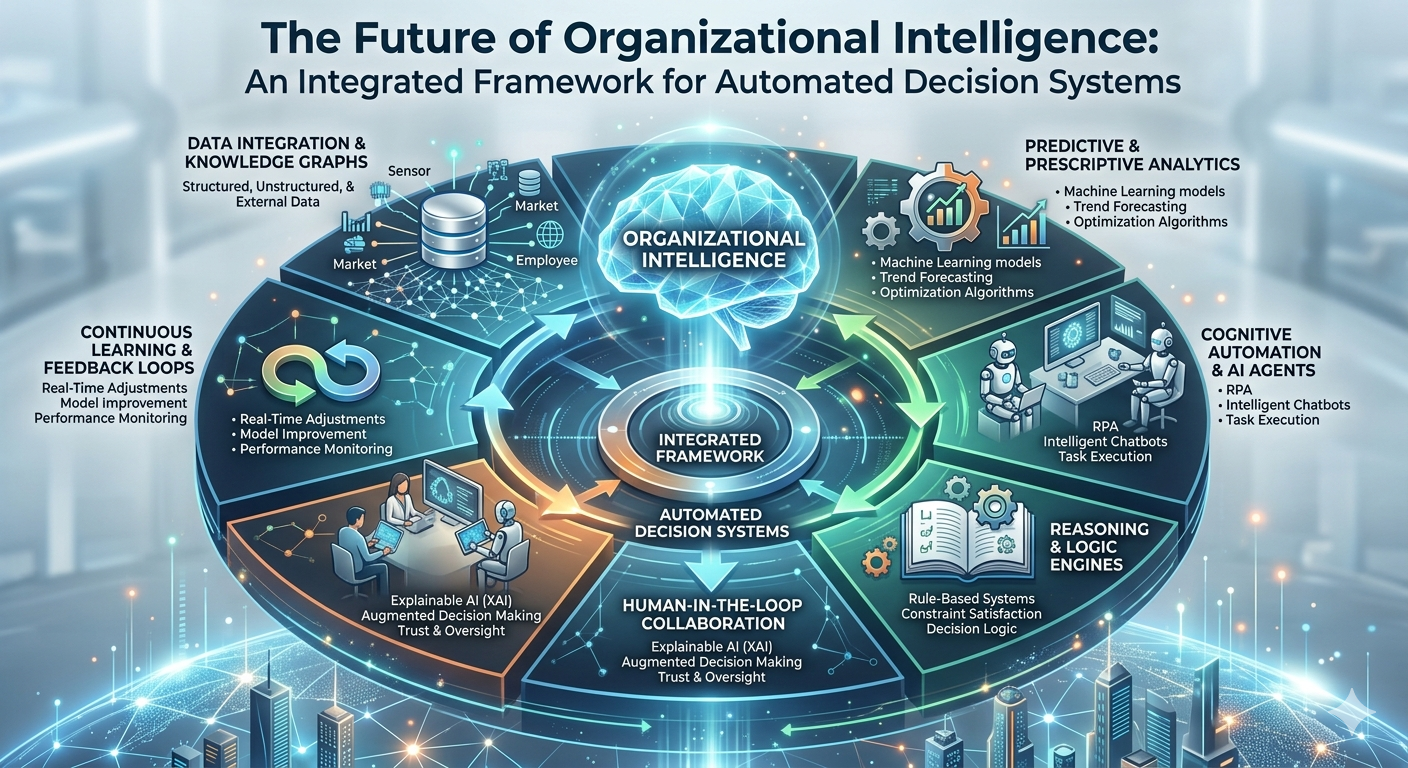
1. Strategic Briefing: The Evolution of Business Intelligence (BI)
In the contemporary high-stakes landscape, Business Intelligence (BI) is no longer a peripheral support function; it is the foundational layer of competitive advantage. Modern BI has transitioned from retrospective reporting—the mere “autopsy” of past performance—to a proactive driver of long-term organizational stability. By synthesizing internal data with external market signals, BI provides the “intelligence” necessary to apprehend interrelationships and guide action toward strategic goals before a competitor can react.
Historical Context Analysis The term “business intelligence” first appeared in Richard Millar Devens’ Cyclopædia of Commercial and Business Anecdotes (1865), describing how banker Sir Henry Furnese maintained a private news network throughout Europe. By receiving news of the fall of Namur prior to his competitors, Furnese acted upon information to secure immense profits. This strategic advantage was formalized in 1958 by IBM’s Hans Peter Luhn, who defined intelligence as the “ability to apprehend interrelationships” to guide action. In 1989, Howard Dresner (later of Gartner) popularized BI as an umbrella term for “fact-based support systems,” shifting the corporate paradigm from business anecdotes to rigorous, evidence-based reasoning.
The Data Landscape: The “Unstructured” Crisis The “So What?” of modern data management lies in the realization that 85% of all business information—emails, memos, videos, and news—is semi-structured or unstructured. This is not merely a storage problem; it is a productivity catastrophe. White-collar workers spend an estimated 30–40% of their time searching for and assessing this data. Without the ability to extract metadata and perform semantic analysis, organizations operate in a state of “informed ignorance,” where the most valuable insights remain trapped in unsearchable silos.
The BI Architectural Stack (Forrester Research Definition)
| Segment | Elements |
| Data Preparation | Information management, data integration, data quality, data warehousing, master-data management, and text- and content-analytics. |
| Data Usage | Reporting, analytics, dashboards, and the transformation of information into tactical, operational, and strategic insights. |
While BI provides the structural infrastructure, the efficacy of the system is ultimately capped by the logical frameworks applied to that data.
——————————————————————————–
2. The Logic Primer: Foundations of Professional Reasoning
In a Volatile, Uncertain, Complex, and Ambiguous (VUCA) environment, the “intuitive” manager is a liability. Disciplined thinking is a strategic necessity, requiring a rigorous commitment to overcoming egocentrism and sociocentrism in corporate decision-making.
The Taxonomy of Reasoning To achieve “algorithmic accountability,” leaders must distinguish between three pillars of logic:
- Deduction: Conclusion by formal structure. If the premises are true, the conclusion must be true (e.g., X is human; all humans have faces; therefore, X has a face).
- Induction: Conclusion by identifying a pattern guaranteed by the strictness of the structure to which it applies. For instance, the mathematical proof that the sum of even integers is always even (2x + 2y = 2(x+y)) provides a structural guarantee of the conclusion.
- Abduction: Conclusion by likelihood or heuristics based on foreknowledge. Observing white sheep in a field and concluding “all sheep are white” is abductive—likely, but not inevitable.
Critical Thinking Waves: From Logicism to Discovery The discipline has evolved from “First Wave” logicism—analytical, objective, and rules-based—to a “Second Wave” of critical thinking. As argued by Kerry Walters, the traditional “calculus of justification” is no longer sufficient. Modern leadership requires “acts of discovery” that incorporate imagination, empathy, and subjectivity. While machines manage the linear justification, humans must lead the non-linear search for novelty.
Core Critical Thinking Skills:
- Interpretation & Analysis: Dissecting argument structures to find unstated assumptions.
- Evaluation & Inference: Drawing warranted conclusions from disparate evidence.
- Metacognition: The “self-corrective habit” of thinking about one’s own thinking to identify biases.
——————————————————————————–
3. The Creative Engine: Cognitive Models for Innovation
Creativity has evolved from the ancient view of “divine conduit” to an essential enterprise competency. During the Renaissance, the shift toward Humanism created an anthropocentric outlook, valuing individual achievement and the intellect as the source of creation rather than discovery.
The Process of Illumination Graham Wallas (1926) detailed a five-stage model of the creative process:
- Preparation: Focused exploration of a problem’s dimensions.
- Incubation: Unconscious internalization of the problem.
- Intimation: The “feeling” that a solution is forthcoming.
- Illumination: The “aha!” moment where the idea bursts into awareness.
- Verification: The conscious elaboration and testing of the idea.
The Four C and Four P Models in Enterprise For leadership, the “Four C” model is a tool for professional development. Managers must foster mini-c (personal learning) and little-c (daily problem solving) while investing in Pro-C (professional expertise) to achieve Big-C (domain-changing) breakthroughs. Simultaneously, the “Four P” model (Person, Process, Product, Press) helps analyze the environment (“Press”) required to transform a novel idea (Creativity) into an implemented reality (Innovation).
——————————————————————————–
4. Integrated Framework: Decision Theory and Utility
The “Anniversary Problem” serves as a perfect microcosm for enterprise resource allocation under uncertainty. A decision-maker must choose between buying flowers (x) or not, based on the probability (p) that it is indeed his anniversary.
Utility Theory Axioms
- Transitivity: If outcome A > B and B > C, then A > C.
- No Fun in Gambling: No intrinsic reward in the lottery; only the prizes matter.
- Continuity: There exists a probability P where one is indifferent between a sure outcome and a gamble.
- Preference: One always prefers a higher probability of a preferred prize.
The Case Study: Mathematical Rigor in Action Using the North paper’s values, we assign numerical utility to four outcomes:
- Domestic Bliss (Flowers + Anniversary): $100 (u=1.0)
- Status Quo (No Flowers + No Anniversary): $80 (u=0.91)
- Suspicious Wife (Flowers + No Anniversary): $42 (u=0.667)
- Doghouse (No Flowers + Anniversary): $0 (u=0)
If the prior probability of it being the anniversary is 0.2:
- Expected Utility (Buy Flowers): 0.2(1.0) + 0.8(0.667) = 0.734
- Expected Utility (No Flowers): 0.8(0.91) + 0.2(0) = 0.728 Decision: Buy the flowers (0.734 > 0.728).
The Value of Information If the husband calls his secretary (costing 10 in “office heckling”), Bayes’ Rule updates his assessment. If the secretary says “Yes,” the revised probability becomes 0.333. The **Value of Perfect Information**—the maximum one should pay to resolve all uncertainty—is calculated at **33.50**. This demonstrates that information has a quantifiable monetary value.
“Choosing an alternative consistent with preferences and knowledge does not guarantee the most profitable outcome in hindsight. We must distinguish between a good decision and a good outcome.” — D. Warner North
——————————————————————————–
5. Decision Intelligence Platforms (DIP): The Technical Landscape
DIPs represent the convergence of BI, AI, and Decision Theory. They solve the 30-40% productivity loss in unstructured data not through simple search, but through Decision Service Composition and Graph Technology, which connect internal and external data to create contextualized views.
Core Platform Capabilities (Gartner Definition):
- Decision Collaboration: Managing human-AI delegation and ethics guardrails.
- Decision Execution: Orchestrating real-time operations of decision services.
- Decision Modeling: Visual, low-code interfaces to frame decisions.
- Decision Monitoring: Auditing the flow and providing alerts for adaptation.
- Decision Governance: Governing decisions as assets via logging and auditing.
Market Snapshot: Leading Tier-1 Products
- Microsoft Fabric: A unified “all-in-one” analytics environment for data science and BI.
- Aera Decision Cloud: Focuses on real-time recommendations and autonomous actions.
- Cloverpop: Dedicated to structured decision recording and team collaboration.
- Quantexa: Uses graph technology to create contextual views of people and events.
- Snowfire AI: Targeted at Fortune 5000 firms to break “data chaos” and silos.
——————————————————————————–
6. Executive Strategy: Implementation and Governance
The transition to a “decision-centric architecture” requires moving from the traditional Business Intelligence Competency Center (BICC)—which focuses on reporting and infrastructure—to the Analytics Competency Center (ACC). The ACC is a knowledge-oriented shared service focused on data mining, use-case formulation, and the adoption of advanced analytics.
Risk and Compliance: The GDPR Paradox Legislation like GDPR has placed strict responsibilities on data users. However, it has also revealed opportunities. By forcing “Decision Governance” and auditability, GDPR compliance ensures that personalization strategies are built on a bedrock of clean, ethical data, ultimately increasing market share through consumer trust.
Strategic Roadmap: Organizations should begin with a Deterministic Phase (sensitivity analysis) to identify which variables most affect outcomes before moving to full Automated Intelligence, where uncertainty is encoded via prior distributions and updated through Bayes’ Rule.
——————————————————————————–
7. Strategic Synthesis: The “So What?” for the Professional
The Competitive Edge in the Age of Generative BI
In an era where Microsoft Copilot can generate reports in seconds, your value as a professional has shifted. Having the data is no longer the win; having the logic is.
- Unstructured Data is Your Largest Asset: Stop ignoring the 85% of your data that is unstructured. DIPs use semantic analysis to turn emails and memos into “Decision Services.”
- Process Trumps Outcome: You can make a brilliant decision and still end up in the “doghouse” due to bad luck. Focus on the utility curve, not the result.
- The Power of $33.50: Every piece of information has a “Certain Equivalent” value. If your data gathering costs more than the uncertainty it resolves, you are losing money.
- BICC is Dead; Long Live the ACC: If your team is only making dashboards, you are behind. You need a center of excellence that identifies high-value use cases for machine learning.
- Ethics is Logic: GDPR is not just a hurdle; it is a framework for Decision Governance. Transparency in how decisions are made is the new brand loyalty.
Final Call to Action: Generative AI handles the “calculus of justification.” Your job is Reflective Contextualization—the ability to provide the logic, ethics, and human context that a machine cannot simulate.
——————————————————————————–
8. Professional Development Suite
Short-Answer Quiz
- Contrast Sir Henry Furnese’s use of information with modern BI: How does the “fall of Namur” illustrate strategic intelligence?
- Explain the difference between a simple search for “felony” and semantic analysis in unstructured data.
- Define the “No Fun in Gambling” axiom and its impact on utility.
- How does the “Transitivity” axiom prevent a decision-maker from becoming a “money pump”?
- Why is an Analytics Competency Center (ACC) better suited for modern enterprise needs than a traditional BICC?
Suggested Essay Questions
- Evaluate Kerry Walters’ critique of “Logicism.” How do “acts of discovery” provide a competitive edge that DIPs cannot automate?
- Analyze the “Value of Perfect Information.” Using the Anniversary Problem, argue why an organization might choose not to invest in further data collection.
- Discuss the “Humanist” shift during the Renaissance and its relationship to the modern “Four C” model of creativity.
Glossary of Key Terms
- Certain Equivalent: The sure amount of money a decision-maker would accept to be indifferent to a risky lottery.
- Likelihood Function: The probability of an outcome E given a specific parameter value p.
- Metadata: Data about the actual content (summaries, topics, people) used to solve the unstructured data search crisis.
- Transitivity: A logic axiom: If A is preferred to B and B to C, then A must be preferred to C.
- BICC: A team focused on the governance, reporting, and infrastructure of BI.
- Abduction: Reasoning from the most likely heuristic; useful for speed but lacking structural guarantee.
- Decision Intelligence Platform (DIP): Software that orchestrates data, AI, and human collaboration for decision modeling.
- Posterior Probability Distribution: The “updated” belief assessment after new data is incorporated via Bayes’ Rule.
- Anthropocentric Outlook: The Renaissance view placing human intellect and achievement at the center of the world.
- Calculus of Justification: Linear, rules-based logical procedures characteristic of “First Wave” critical thinking.
Leave a Reply