

Introduction
The internet was built as a web of documents—pages linked to pages, text connected to text. But the world is not made of documents.
It is made of things:
- People
- Organizations
- Products
- Devices
- Events
The gap between these real-world entities and how machines understand them is where most digital systems fall short.
This is where Schema.org becomes foundational.
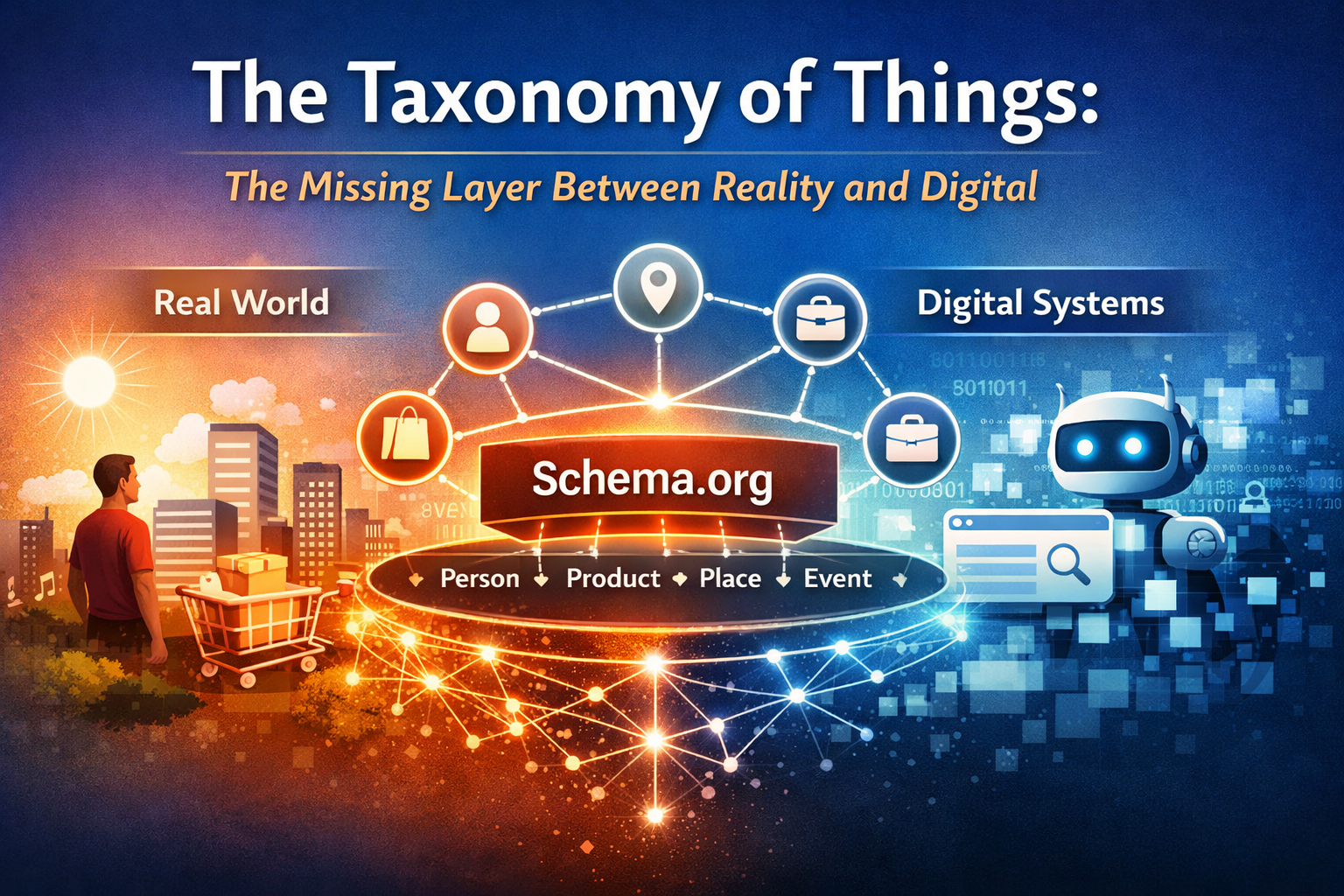
Schema.org is not just an SEO tool—it is the missing ontological layer that connects reality to digital systems.
The Problem: Machines See Text, Not Meaning
Consider a simple sentence:
“Apple is hiring engineers in Bangalore.”
To a human, this is obvious:
- Apple → a company
- Hiring → an action
- Engineers → roles
- Bangalore → a place
To a machine, without structure:
- It’s just a string of words.
There is no inherent meaning, no clear entities, no relationships.
The Missing Layer: A Taxonomy of Things
Schema.org introduces a structured way to describe the world using a shared vocabulary.
At its core, everything begins with one type:
Thing
From there, it branches into a taxonomy:
PersonOrganizationPlaceProductEventCreativeWork- and hundreds more
Each entity has:
- Properties → name, location, price, author
- Relationships → worksFor, owns, locatedIn
This transforms raw content into machine-understandable knowledge.
From Text to Meaning
Let’s revisit the earlier example.
Without structure:
Apple is hiring engineers in Bangalore
With Schema.org:
Organization: Apple
Action: hiring
JobRole: Engineer
Location: Bangalore
Now the system understands:
- Who is acting
- What action is happening
- Where it is happening
This is the difference between:
Reading text vs understanding reality
From Web of Documents → Web of Things
The traditional web:
- Pages linked by URLs
- Content optimized for humans
The emerging web:
- Entities linked by meaning
- Systems optimized for machines and AI
Schema.org enables this transformation by:
- Converting content into entities
- Defining relationships between entities
- Enabling knowledge graphs
This is how search engines evolved from:
- keyword matching → entity understanding
The Role of Knowledge Graphs
When structured data is applied at scale, it forms knowledge graphs:
- Nodes = entities (people, places, products)
- Edges = relationships
These graphs power:
- Search engines
- AI assistants
- recommendation systems
Without a consistent taxonomy, these graphs cannot exist reliably.
Schema.org acts as:
The common language that makes knowledge graphs interoperable
Why This Matters in the AI Era
We are moving into a world driven by:
- AI agents
- autonomous systems
- machine-to-machine interactions
These systems require:
- structured understanding
- not just unstructured content
Schema.org provides:
- A baseline ontology
- A shared understanding of “what exists”
This is critical for:
- AI reasoning
- automation
- interoperability
The Deeper Insight: Ontology as Infrastructure
Your framing—“The Taxonomy of Things”—captures something deeper:
The internet doesn’t just need data.
It needs a definition of reality.
Schema.org is:
- not just metadata
- not just markup
It is:
An ontology layer for the digital world
It defines:
- What a “Person” is
- What a “Product” is
- What an “Organization” is
Without this, systems cannot reason consistently.
Connecting to the Next Layer: Authorization (CAAS Perspective)
If Schema.org answers:
What is this thing?
Then systems like your CAAS (Continuous Autonomous Authorization System) answer:
What is this thing allowed to do right now?
This creates a powerful stack:
| Layer | Purpose |
|---|---|
| Reality | Actual entities |
| Schema.org | Defines identity & meaning |
| Knowledge Graphs | Define relationships |
| CAAS | Defines permissions & behavior |
| Applications / AI | Execute actions |
Together, this becomes:
A complete infrastructure for autonomous digital systems
The Future: From Static Data to Living Systems
As the web evolves:
- Static pages → dynamic entities
- APIs → semantic systems
- Users → agents
The importance of a shared taxonomy grows.
In the future:
- Every entity (human, device, AI agent) will be:
- Defined (Schema.org-like ontology)
- Connected (knowledge graphs)
- Governed (authorization systems like CAAS)
Conclusion
The internet is undergoing a fundamental shift:
From documents → things
From text → meaning
From data → knowledge
Schema.org sits at the center of this transformation.
It is:
- the taxonomy of things
- the bridge between reality and machines
- the foundation for AI-native systems
And most importantly:
It is the missing layer we didn’t know we needed—until now.
Leave a Reply