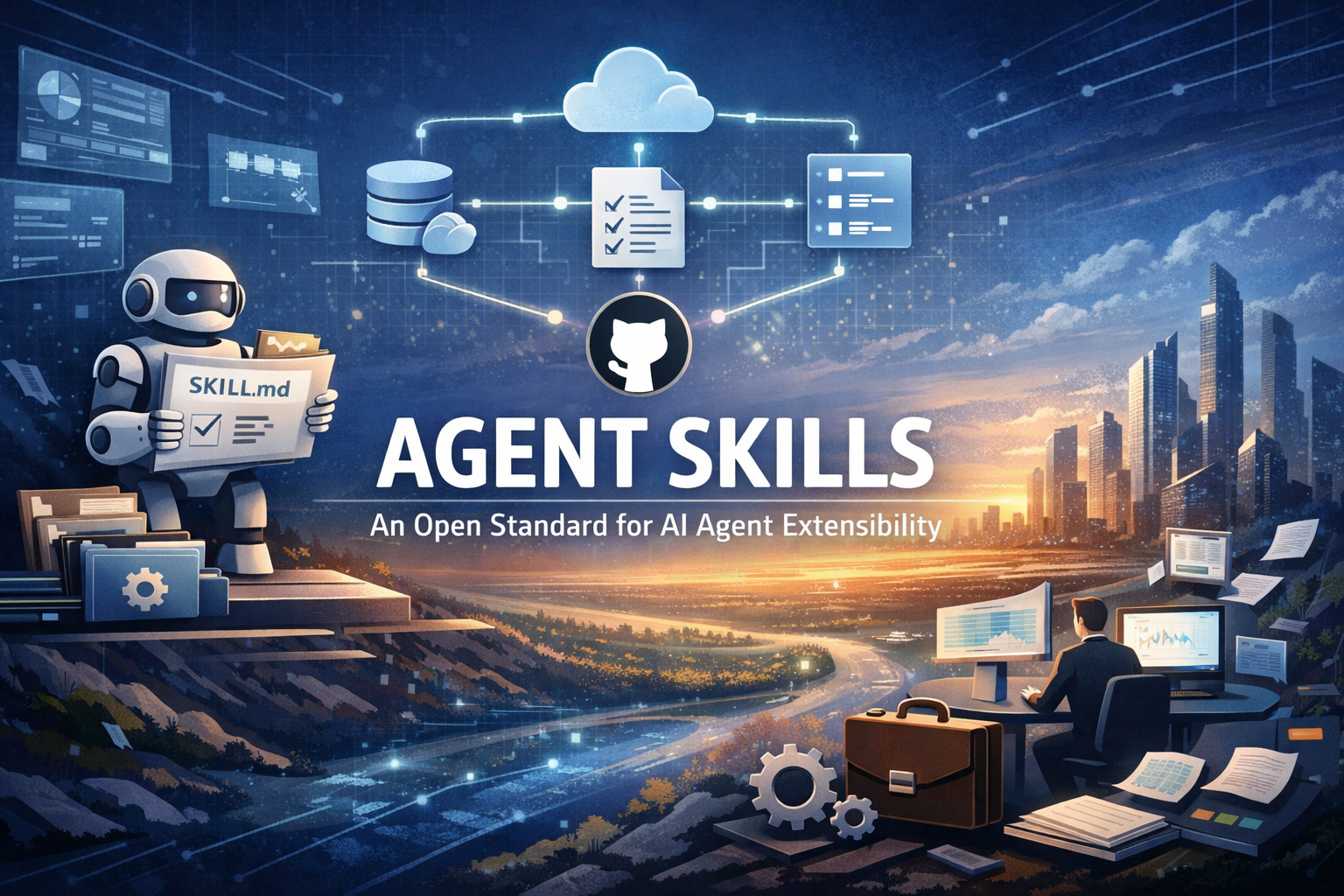
Introduction: The Context Gap and the Reliability Crisis
We have reached a paradoxical moment in the AI evolution. On one hand, Large Language Models (LLMs) demonstrate breathtaking reasoning capabilities; on the other, they remain plagued by a “reliability crisis.” In a professional setting, a “clever” agent that hallucinates a process or misses a critical step is more than a nuisance—it’s a liability. The current generation of agents often acts as jacks-of-all-trades that lack the specific procedural rigors required to perform “real work” with the precision of a human expert.
“Agent Skills” is the industry’s answer to this maturity gap. Developed as an open standard, it provides a structured, simple format for packaging specialized expertise. By moving away from unpredictable prompt engineering and toward a system of loadable, domain-specific knowledge, we are finally bridging the gap between raw intelligence and dependable utility.
Takeaway 1: From Generalists to Specialists (On-Demand Expertise)
The fundamental shift here is moving from a monolithic model to a modular one. An “Agent Skill” is essentially a structured folder containing instructions, scripts, and resources. This architecture allows agents to move beyond general logic and adopt the specific persona and procedural knowledge required for a task at hand.
By loading these folders on demand, agents gain access to narrow domain expertise—such as the granular nuances of a legal review or the technical requirements of a complex data analysis pipeline. This ensures that the agent is not guessing how to perform a task but is following a codified set of scripts and instructions.
“Agents are increasingly capable, but often don’t have the context they need to do real work reliably. Skills solve this by giving agents access to procedural knowledge and company-, team-, and user-specific context they can load on demand.”
Takeaway 2: The “Build Once, Deploy Everywhere” Advantage
In the early days of agentic AI, fragmentation was the norm. A capability built for one platform was often trapped within that specific walled garden. The Agent Skills standard disrupts this by prioritizing interoperability, creating a “build once, deploy anywhere” ecosystem that benefits every stakeholder in the AI value chain:
• Skill Authors: Developers can package a capability—like a specialized financial auditing script—a single time and have it remain functional across multiple agent products.
• Compatible Agents: AI platforms supporting the standard can instantly offer their users a library of new capabilities “out of the box” without needing to build every feature from scratch.
• Teams and Enterprises: Organizations can capture their unique, internal institutional knowledge in portable packages that work seamlessly across different tools and vendors.
Takeaway 3: Turning Multi-Step Chaos into Repeatable Workflows
For a Product Strategist, the most compelling aspect of this framework is the move toward “system utility.” Agent Skills enable an agent to perform actual, multi-step actions—such as creating presentations, building Model Context Protocol (MCP) servers, or analyzing massive datasets—with consistency.
This transforms AI from a “black box” experiment into a repeatable workflow. The focus on auditability is a critical evolution for professional environments. Because a skill is defined by the SKILL.md specification, it provides a transparent roadmap of the agent’s logic. Unlike the opaque, probabilistic nature of raw neural weights, a compliance officer or team lead can read the SKILL.md file to see exactly what an agent is programmed to do. This level of transparency is non-negotiable for regulated industries.
Takeaway 4: The Power of Open Standards and Version Control
While originally developed by Anthropic, the release of Agent Skills as an open standard signals a move toward a more collaborative, less proprietary AI future. This is not just about sharing code; it is about applying software engineering discipline to AI behavior.
Because these skills are packaged as version-controlled folders, they allow an enterprise to treat AI capabilities as managed software assets. In a strategic sense, this means institutional memory is no longer ephemeral or hidden in a “mega-prompt.” It is a versioned asset that can be tracked, audited, and—critically—rolled back if a skill update breaks a production pipeline. This brings a level of governance to AI that has been sorely lacking.
Conclusion: The Future of Portable Intelligence
Agent Skills represent more than just a new folder structure; they represent the professionalization of AI agents. By making intelligence portable, accurate, and efficient, this standard allows us to move past the limitations of the “generalist” model and toward a world of specialized, reliable AI collaborators.
This framework changes how teams manage their internal knowledge, turning abstract expertise into functional, deployable assets that live within the company’s own infrastructure. As the ecosystem matures, the strategic priority for every tech leader becomes clear: Which of your own repeatable, high-value workflows are ready to be packaged into a skill?NotebookLM can be inaccurate; please double-check its responses.
| Feature | Description | Primary Benefit | Intended Users | Capability Type |
| SKILL.md Specification | A complete format specification file used for defining and documenting specific agent skills. | Provides a standardized way to integrate skills into agents or tools. | Developers and Skill Authors | Interoperability |
| Open Format / Standard | A simple, open format originally developed by Anthropic and released as an open standard. | Allows for cross-platform deployment and ecosystem-wide contributions. | Skill Authors and Ecosystem Contributors | Interoperability |
| Instructional Folders | Folders containing instructions, scripts, and resources that agents can discover and use. | Enables agents to perform tasks more accurately and efficiently. | Developers and Agent Products | Workflow Automation |
| Domain Expertise Packaging | Specialized knowledge (e.g., legal review, data analysis) packaged into reusable instructions. | Standardizes complex professional knowledge for consistent agent use. | Skill Authors and Subject Matter Experts | Domain Expertise |
| Procedural Knowledge & Context | Access to company-, team-, and user-specific context loaded on demand for specific tasks. | Provides agents with necessary context to perform real-world work reliably. | Teams and Enterprises | Domain Expertise |
| Repeatable Workflows | Multi-step tasks converted into consistent, packaged instruction sets. | Ensures workflows are consistent, auditable, and repeatable across the organization. | Teams and Enterprises | Workflow Automation |
| New Capability Modules | Specific functional additions like creating presentations or building MCP servers. | Extends agent functionality out of the box for end users. | End Users and Developers | New Capabilities |
| Portable Version-Controlled Packages | Organizational knowledge captured in portable, versioned, and manageable formats. | Enables the secure and manageable capture of institutional knowledge. | Teams and Enterprises | Knowledge Management |
Leave a Reply