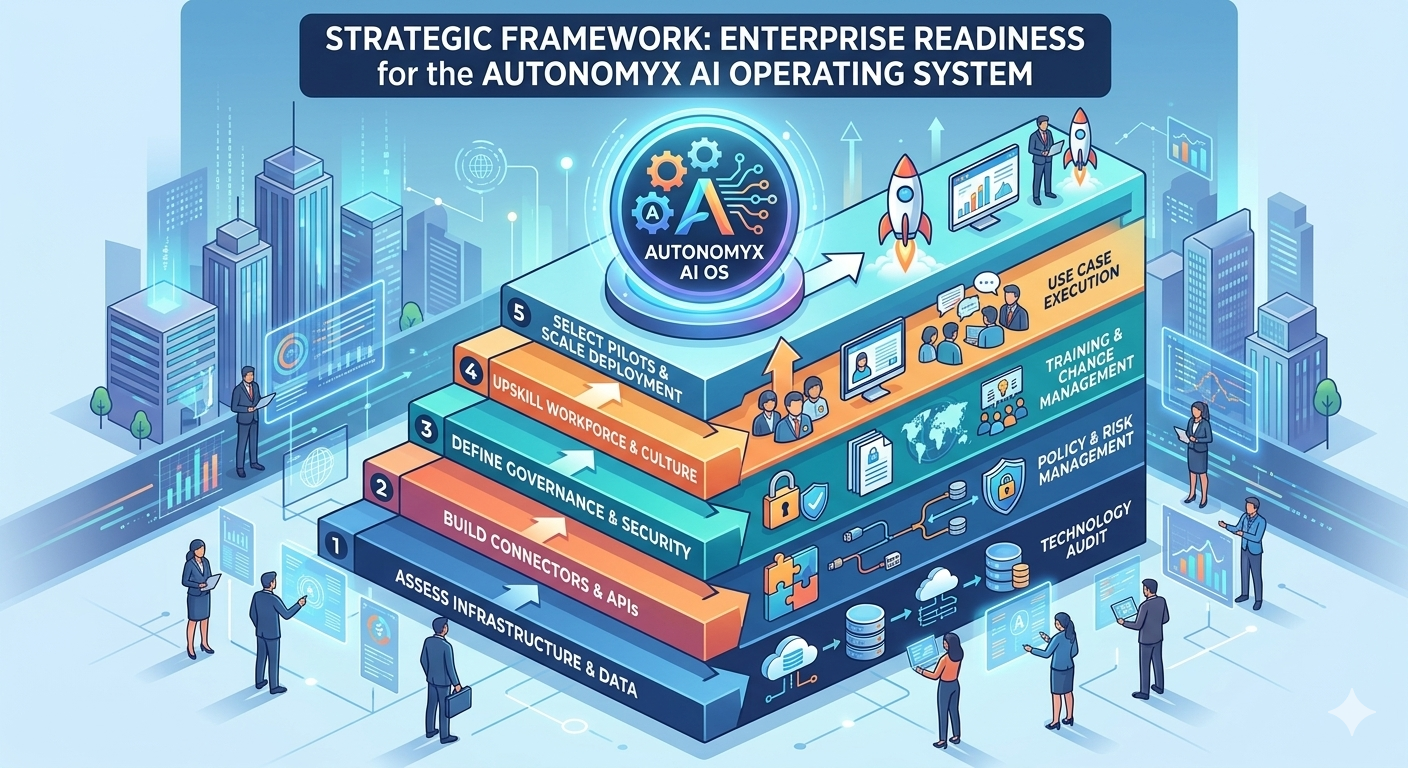
1. The Strategic Shift: From Manual Silos to a Hybrid AI-Human Workforce
The modern enterprise has reached an architectural inflection point. The legacy model of siloed, manual processes is being superseded by a hybrid human-AI workforce where agents do not merely assist humans but execute complex, goal-oriented business logic. In this paradigm, Autonomyx is not a discrete SaaS tool; it is a foundational AI Operating System (AI-OS). This platform serves as the essential orchestration layer, bridging the gap between volatile LLM innovation and stable corporate operations. Guided by the Autonomyx Principles—Open Innovation, Collaboration, and acting as a Platform-as-a-Gap-Filler—this OS simplifies technology while serving as a trusted partner to improve security posture and productivity within strict budgetary and time-bound constraints.
To navigate this transition, leadership must recognize that autonomous orchestration is a fundamental departure from traditional linear automation.
Traditional Task Automation vs. Autonomous Agent Orchestration
| Dimension | Traditional Task Automation | Autonomous Agent Orchestration |
| Reasoning Engine | Deterministic; follows rigid “if-then” logic. | Cognitive; leverages LLMs for reasoning and ambiguity. |
| Adaptability | Brittle; fails when UI or variables shift. | Dynamic; self-corrects via feedback and reasoning. |
| Decision-Making | Human-led; requires manual intervention. | Autonomous; goal-oriented execution within bounds. |
| Scalability | Linear; requires more scripts per task. | Exponential; a Global AI Network where agents learn. |
| Core Architecture | Isolated silos and disconnected scripts. | Centralized AI-OS with shared memory and tools. |
While organizational vision sets the direction, the viability of a hybrid workforce depends entirely on the underlying technical architecture to ensure sovereignty and risk mitigation.
——————————————————————————–
2. Architecture Sovereignty: Data Control and Global Compliance
For the C-suite, data sovereignty is a non-negotiable pillar of AI strategy. The Autonomyx Control Plane functions as the “Kubernetes for AI Agents,” providing a centralized management layer that allows for decentralized execution without compromising data ownership. This architecture ensures that sensitive corporate intelligence remains within protected perimeters, mitigating the risks of data leakage associated with public AI models.
The Control Plane: Deployment Parameters
The Autonomyx architecture supports three sovereign deployment models designed for maximum security:
- Private Cloud: Hosted within the enterprise’s AWS, Azure, or GCP VPCs, providing isolated resource management while leveraging cloud scalability.
- On-Premise: Deployed on internal hardware for organizations requiring total physical control over their AI infrastructure.
- Air-Gapped: Zero external internet connectivity, designed for high-security environments like Defense, Banking, or Government, preventing all unauthorized data exfiltration.
Enterprise Security & Compliance Checklist
Leadership must verify that their AI-OS implementation aligns with these global standards:
- [ ] Data Masking & PII Protection: Does the system automatically scrub Personally Identifiable Information before it reaches the reasoning layer?
- [ ] GDPR & HIPAA Compliance: Are there technical safeguards for the “Right to be Forgotten” and the protection of sensitive health data?
- [ ] SOC2 Type II Auditability: Does the platform maintain immutable logs of every agent decision and data access event?
- [ ] RBAC (Role-Based Access Control): Are permissions granularly restricted at the Organization Node level?
Securing the data foundation is paramount; however, the strategic value is only realized when this data is integrated into the existing corporate stack through a resilient buffer layer.
——————————————————————————–
3. Integration Synergy: Buffer Layers and Stack Alignment
A primary risk of AI adoption is the creation of new technical debt. Autonomyx acts as a strategic Integration Layer—a buffer that shields stable legacy systems (CRMs, ERPs) from the volatility of LLM updates. By utilizing standardized mechanisms like APIs, Webhooks, and OAuth, Autonomyx enables White-Labeling and Dynamic Branding Layers, allowing organizations to customize the AI experience for different departments or clients.
Interface Mechanisms for Legacy Systems
Autonomyx leverages a robust Automation Engine (powered by n8n or Zapier) to interface with the corporate stack:
- CRM (Salesforce, HubSpot): Synchronizes lead enrichment and sales pipelines via OAuth.
- Helpdesk (Zendesk, Freshdesk): Triages tickets and automates first-line responses via APIs.
- Productivity (Slack, Microsoft Teams): Embeds the AI-OS directly into communication flows via Webhooks.
- Vector Knowledge Engine: Connects to Vector Databases (Pinecone, Weaviate, or Supabase) to provide agents with a high-fidelity RAG (Retrieval-Augmented Generation) knowledge layer.
The Model Router: Cost and Performance Optimization
To maintain budgetary alignment, the Autonomyx Model Router intelligently directs traffic based on task complexity:
- Frontier Tasks: Routed to OpenAI (GPT-4) or Anthropic (Claude) for deep reasoning.
- Privacy-Sensitive/Routine Tasks: Routed to Private LLMs (Llama, Mistral) to ensure data sovereignty and eliminate external token costs.
This integration synergy provides the plumbing for a multi-tenant environment where governance is managed at scale.
——————————————————————————–
4. The Multi-Tenant Deployment Model: Governance and Isolation
For large-scale enterprises, innovation must be decentralized but control must remain centralized. The Autonomyx Multi-Tenant AI Platform allows different business units to innovate independently within isolated nodes while adhering to a master corporate policy.
The Organization Node Structure
Organization Nodes (Org A, Org B): Unlike traditional shared-instance SaaS, Autonomyx provides true multi-tenancy. Each Org Node (e.g., Finance vs. Marketing) is logically and physically isolated. Finance’s Vector Knowledge Engine and private workflows are inaccessible to the Marketing Node, ensuring that sensitive data never crosses organizational boundaries.
Governance via the Policy Engine
The Policy Engine enforces Standard Operating Procedures (SOPs) across all tenants:
- Template Governance SOP: Limits access to specific “AI Templates” (e.g., Legal Research) to authorized departments to prevent tool sprawl.
- Permissioning SOP: Hard-codes boundaries on which agents can trigger external automations (e.g., limiting accounting API access to Finance agents).
- Audit Trail SOP: Centralizes logs from all Organization Nodes into the Control Plane for unified compliance review.
Effective governance frameworks transition the focus from technical control to human oversight via the evaluation loop.
——————————————————————————–
5. Operational Governance: Human-in-the-Loop and Evaluation
Autonomous systems are most effective when they operate within a Human-in-the-Loop (HITL) framework. This ensures that the “Self-Improvement Engine” remains aligned with business intent through continuous human feedback.
Key Performance Indicators (KPIs)
The Evaluation Engine (Evals) and Analytics Engine monitor the health of the digital workforce through critical KPIs:
- Automation Success Rate: The percentage of workflows successfully completed without human intervention.
- Hallucination Rate: Frequency of inaccurate reasoning generated by the LLM.
- Tool Correctness: Percentage of successful API calls relative to the agent’s intent.
- Token Usage Efficiency: Cost-benefit analysis of the Model Router’s decisions.
The Self-Improvement Feedback Loop
The platform utilizes a feedback loop to drive automatic optimization. When a human provides a “Thumbs Up/Down,” the system logs the interaction and utilizes Versioned Prompts (e.g., transitioning from Prompt v1 to Prompt v2). This creates a tangible trail of improvement, allowing agents to learn from failures and refine their reasoning logic over time.
——————————————————————————–
6. Implementation Roadmap and Readiness Checklist
Transitioning to an AI-OS requires a phased, strategic rollout that identifies internal Creators—developers, content writers, and business experts who will build the templates that power the OS.
One-Phase Strategic Roadmap
- Milestone 1: Platform Foundation: Deploy the Control Plane and Kubernetes infrastructure with security protocols.
- Milestone 2: Knowledge Integration: Connect enterprise data to the Vector Knowledge Engine (Pinecone/Weaviate).
- Milestone 3: Creator Onboarding: Identify internal experts to build the first departmental AI Templates.
- Milestone 4: Governance & Eval Deployment: Activate the Policy Engine and establish baseline Evals for initial agents.
- Milestone 5: Global Network Launch: Scale the hybrid workforce across all Organization Nodes.
Enterprise Readiness Scorecard
Rate your organization (1-5) across the following strategic themes:
| Theme | Assessment Criteria | Score |
| Data Readiness | High-fidelity data with clear classification and Vector DB accessibility. | |
| Integration Maturity | API/OAuth accessibility and readiness to sunset legacy manual silos. | |
| Governance Framework | Established compliance (GDPR/SOC2) and defined HITL oversight roles. | |
| Creator Ecosystem | Identification of internal Devs/Writers ready to build AI templates. | |
| Workforce Culture | Organizational openness to hybrid collaboration and upskilling. | |
| Budget & Timeline | Alignment of AI initiatives with current fiscal constraints and deadlines. | |
| Total Score | Aim for 22/30 for immediate full-scale deployment. |
Conclusion
Autonomyx is the definitive AI Operating System for the modern enterprise. By unifying reasoning, knowledge, and action within a secure, multi-tenant Control Plane, Autonomyx enables organizations to build a resilient, self-improving hybrid workforce. Leadership must now align on these architectural standards to ensure the transition to autonomy is secure, compliant, and strategically transformative.
Leave a Reply