Executive Summary
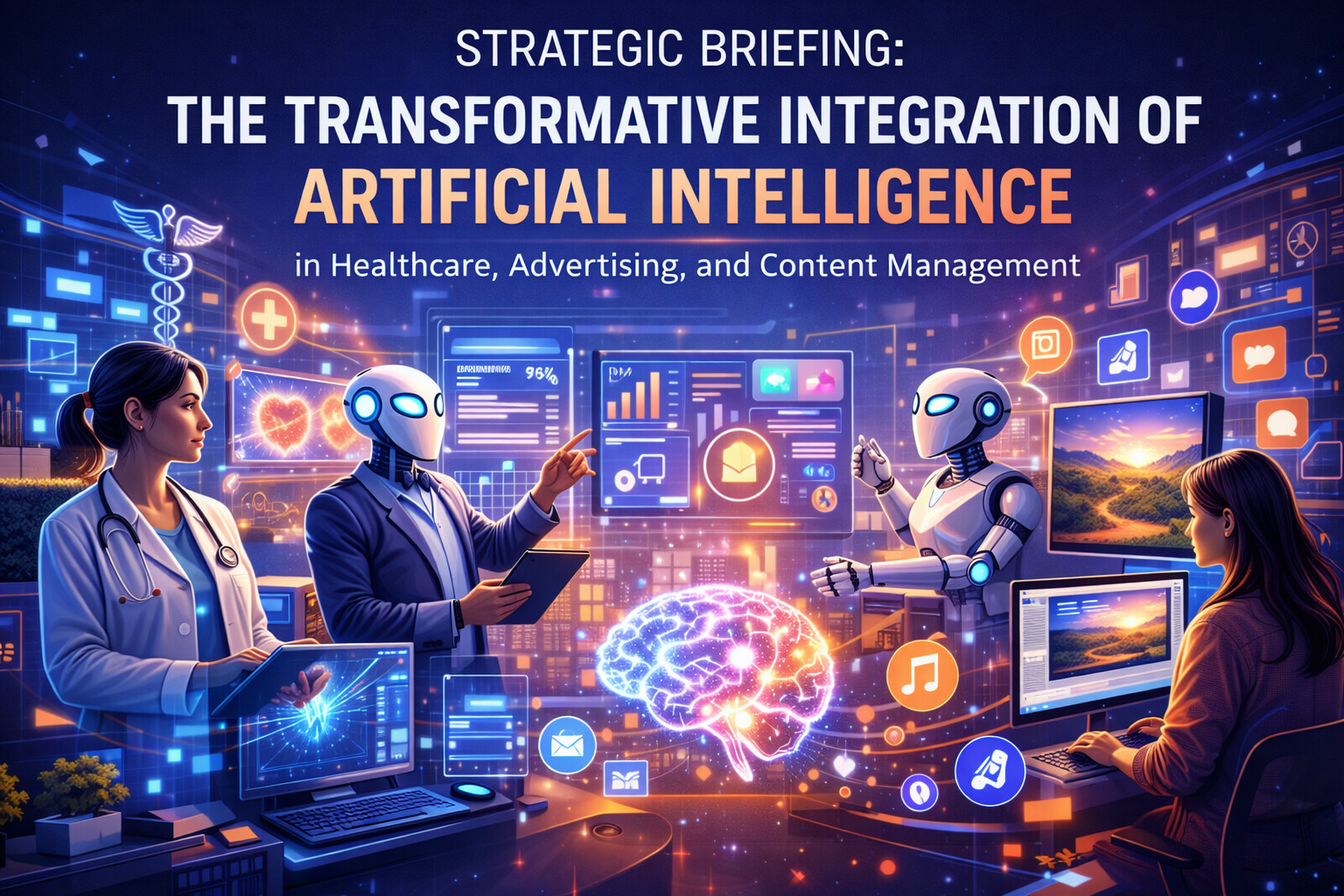
Artificial Intelligence (AI) has transitioned from a backend analytical tool into a proactive reasoning and creative engine across the healthcare, advertising, and digital content sectors. This briefing examines the emergence of AI-Supported Shared Decision-Making (AI-SDM) in clinical settings, the technical revolution of hyper-personalization in advertising, and the evolution of Headless and Decoupled Content Management Systems (CMS).
Key takeaways include:
- From Explainability to Reasoning: In healthcare, the focus is shifting from technical transparency (XAI) to clinical reasoning, providing “why” a recommendation is relevant to a specific patient context.
- The Rise of Agentic AI: Advertising and content management are moving toward “agentic” systems—autonomous agents capable of planning, executing, and optimizing multi-step workflows with minimal human intervention.
- Architectural Flexibility: The industry is favoring Headless and Decoupled architectures to support omnichannel content delivery and AI-driven automation.
- Ethical and Regulatory Imperatives: Addressing algorithmic bias, data privacy, and “hallucinations” (factually incorrect outputs) is critical for institutional adoption and public trust.
——————————————————————————–
I. AI-Supported Shared Decision-Making (AI-SDM) in Healthcare
The integration of AI into healthcare requires a shift toward patient-centered care. The AI-SDM framework is designed to bridge the gap between technical AI outputs and clinical dialogue.
AI Reasoning vs. AI Explainability (XAI)
The framework distinguishes between the technical mechanics of an algorithm and the narrative justification required for medical decisions.
| Feature | AI Explainability (XAI) | AI Reasoning (for AI-SDM) |
| Focus | Internal algorithmic logic | Clinical relevance and justification |
| Goal | Model validation and debugging | Facilitate understanding and deliberation |
| Audience | Developers and data scientists | Healthcare professionals (HCPs) and patients |
| Primary Question | “How did the system produce the output?” | “Why is this output relevant for the patient?” |
| Example Output | Heatmaps, feature importance scores | Contextual narrative, risk/benefit summary |
The AI-SDM Conceptual Model
AI-SDM mimics the dual-process theory of clinical cognition, pairing analytical reasoning (predictive models) with narrative synthesis (generative reasoning). It operates in four phases:
- Input and Context Collection: Gathering HCP medical history, patient values, and AI-derived evidence (from clinical guidelines and literature via Natural Language Processing).
- AI Reasoning Generation: Synthesizing models to produce evidence-based reports for HCPs and interactive, tailored explanations for patients.
- Interactive Deliberation: A triadic process where HCPs, patients, and AI outputs interact. AI reasoning is refined in real-time based on patient queries or clinician adjustments.
- Implementation and Documentation: Reaching a consensus and using AI to generate personalized follow-up plans and transparent medical records.
Clinical Application: Stroke Management
In cases of acute ischemic stroke for elderly patients, AI-SDM facilitates high-stakes decisions regarding mechanical thrombectomy. It integrates DAWN and DEFUSE-3 trial data to estimate independence probabilities versus hemorrhage risks, translating these into recovery trajectories that a patient can understand.
——————————————————————————–
II. The Technical Revolution in Advertising
AI is fundamentally altering how brands connect with consumers through scale, efficiency, and real-time optimization.
Key Pillars of AI-Driven Advertising
- Hyper-Personalization: Algorithms analyze vast datasets (browsing history, purchase patterns) to segment micro-audiences. Examples include Starbucks’ personalized recommendations and Spotify’s tailored campaigns.
- Programmatic Advertising: Systems like Meta’s Lattice and Google Ads’ Smart Bidding automate ad placement and bidding in real-time, processing millions of requests per second.
- Generative Creative Development: Large Language Models (LLMs) and tools like DALL-E generate ad copy, images, and video. Coca-Cola’s “Create Real Magic” campaign utilized these to allow artists to craft AI-generated artwork at scale.
Competitive Landscape: “Corporate Chess”
- Tech Giants: Alphabet, Meta, Amazon, and Microsoft leverage vast data reserves to refine AI models. Amazon, for instance, uses AI to personalize ad images to individual consumers to boost engagement.
- Specialized AI & Startups: Companies like Salesforce (AI CRM) and startups like Bestever provide niche, agile solutions, democratizing high-end advertising capabilities for smaller brands.
- Disruption: The rise of “Answer Engine Optimization” (AEO) and AI search agents is expected to impact traditional SEO and ad revenue models by reducing organic traffic to websites.
——————————————————————————–
III. Content Management and Web Development Architectures
As digital experiences expand beyond websites to IoT and mobile apps, traditional CMS structures are becoming obsolete.
Headless vs. Decoupled CMS
Modern organizations are adopting architectures that separate content storage from presentation.
- Decoupled CMS: Separates the backend from the frontend but retains a default frontend delivery system. It is ideal for teams needing an out-of-the-box solution with API flexibility.
- Headless CMS: Completely front-end agnostic. Content is delivered purely via APIs. It offers maximum flexibility for omnichannel delivery (smartwatches, billboards, apps) but requires significant developer resources.
- Agentic Cloud OS: Platforms like Orbitype integrate AI agents directly into the workflow, enabling autonomous content lifecycle management, from creation to archival.
Responsive Website Builders (2026 Landscape)
Responsive builders empower non-technical users to create mobile-optimized sites. Notable platforms include:
- Wix: Features Artificial Design Intelligence (ADI) for rapid site generation.
- Squarespace: Focused on high-end visual aesthetics and designer templates.
- Webflow: Bridges no-code and developer-level control with clean HTML/CSS output.
- Duda: Targeted at agencies managing multiple client sites at scale.
- GoDaddy: Emphasizes speed-to-market using AI-powered design assistance.
——————————————————————————–
IV. Cross-Sector Challenges and Ethical Governance
The adoption of AI is hampered by consistent risks across healthcare, advertising, and technology sectors.
Primary Challenges
- Algorithmic Bias: AI models can perpetuate societal prejudices if trained on biased data. Future deployments suggest a 4-layer governance loop including fairness-aware algorithms and real-time performance dashboards.
- Data Privacy: Strict adherence to regulations like HIPAA (US), GDPR (Europe), and regional standards (e.g., Saudi Arabia) is non-negotiable.
- Hallucinations and Misinformation: Generative AI can produce factually incorrect or “off-brand” material. In healthcare, outputs must be anchored to explicit citations from validated guidelines.
- Transparency and the “Black Box” Problem: The lack of visibility into AI decision-making hinders accountability.
Future Directions: Agentic and Affective AI
The next epoch of AI involves Agentic AI systems that can independently plan and execute campaigns. Furthermore, the integration of Affective Intelligence—using multimodal emotion recognition (facial microexpressions, vocal prosody)—aims to reduce bias and improve trust in sensitive clinical or consumer interactions.
Implementation Roadmap for Organizations
- Technical Integration: Leverage interoperability standards like FHIR and SNOMED CT.
- Stakeholder Readiness: Train professionals to act as “maestros” who oversee and guide AI rather than being replaced by it.
- Continuous Auditing: Establish dynamic fairness auditing and post-market surveillance to ensure ongoing safety and equity.
Leave a Reply