Introduction
Search is broken.
Not because it doesn’t return results—but because it returns too many, too shallow, and often too disconnected from what the user actually wants.
When you search today, you don’t want links.
You want answers.
You want context.
You want structured intelligence.
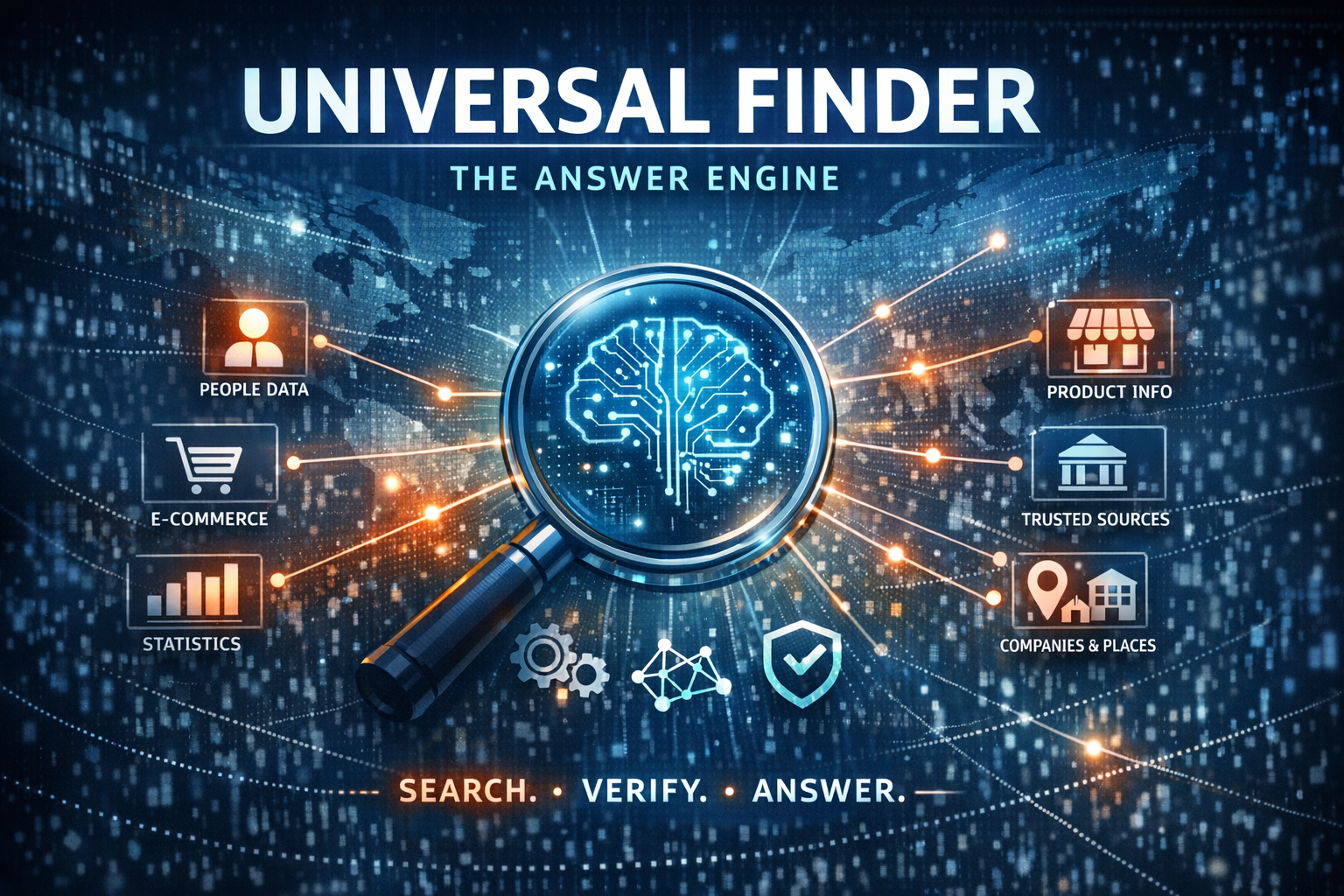
That’s exactly what we’re building: a Universal Finder — a system that doesn’t just search, but understands, routes, verifies, and answers.
The Problem with Traditional Search
Traditional search engines are optimized for:
- Keywords → Links
- Ranking → Clicks
- Volume → Ads
But modern users—and especially AI agents—need:
- Context-aware answers
- Verified data
- Multi-source intelligence
- Real-time relevance
A query like:
“Find a CRM for startups with pricing and features”
should not return 10 blog links.
It should return a decision-ready answer.
What is the Universal Finder?
The Universal Finder is an intelligent system that:
- Understands the intent of a query
- Identifies the type of search
- Routes to the best data source or tool
- Verifies and enriches results
- Returns a structured, source-backed answer
It transforms search from:
👉 “Find information”
to
👉 “Answer the question”
Core Search Modes
The system dynamically detects the type of query and adapts accordingly:
1. People Search
- Identity, role, background
- Employment via LinkedIn
- Verified social profiles
- Relationship graph
2. Product Search
- Features, pricing, vendor
- Documentation and official sources
3. Commerce Search
- Amazon or marketplace data
- Price, ratings, seller, availability
4. Topic Search
- Definition and scope
- Starts with Wikipedia
- Enriched with authoritative sources
5. Data Search
- Exact metrics (value, unit, timeframe)
- Official statistical sources
- Methodology and caveats
6. Automotive Search
- Manufacturer data
- Specs, trims, pricing
- Reviews from automotive platforms
7. Entity Search
- Companies, organizations, places
- Ownership, leadership, structure
Intelligent Source Routing
Instead of blindly searching the web, the Finder chooses the best source:
| Use Case | Preferred Source |
|---|---|
| Topics | Wikipedia |
| Products | Official websites |
| E-commerce | Amazon |
| Employment | |
| Data | Government / institutional sources |
| Automotive | Manufacturer + auto platforms |
| People | Verified public profiles |
This ensures:
- Higher accuracy
- Less noise
- Faster answers
From Profiles to Graphs
One of the most powerful capabilities is relationship mapping.
For people and organizations, the Finder doesn’t just list data—it builds connections.
Example:
graph TD
  Satya["Satya Nadella"]
  Microsoft["Microsoft"]
  LinkedIn["LinkedIn"]
  Twitter["X / Twitter"]

  Satya --> Microsoft
  Satya --> LinkedIn
  Satya --> Twitter
This enables:
- Network intelligence
- Organizational mapping
- Contextual understanding
Privacy-First Design
Unlike traditional scraping systems, the Finder is built with strict boundaries:
- ❌ No private social graphs
- ❌ No hidden friend lists
- ❌ No inferred personal data
Only uses:
- Public data
- Authorized data
- User-provided inputs
This is critical for building trustworthy AI systems.
Why This Matters in the Agent-First Era
In an Agent-First world, AI systems are not just assistants—they are:
- Decision-makers
- Operators
- Autonomous actors
These agents need:
- Reliable data
- Structured outputs
- Verifiable sources
The Universal Finder becomes:
👉 The knowledge layer for AI agents
👉 The truth engine behind decisions
From Search Engine to Answer Engine
This shift is fundamental:
| Old World | New World |
|---|---|
| Search → Links | Search → Answers |
| Static pages | Dynamic intelligence |
| Human browsing | AI consumption |
| Keywords | Intent |
The Bigger Vision
The Universal Finder is not just a tool—it’s a foundation layer for:
- Autonomous systems
- AI-powered workflows
- Decision intelligence platforms
- Zero-trust knowledge systems
Combined with platforms like CaaS (Continuous Autonomous Authorization System), it enables:
👉 Not just who can access what
👉 But what is true, relevant, and trustworthy
Conclusion
We are moving from:
- Information overload
to - Intelligence on demand
The future of search is not about finding documents.
It’s about delivering answers with confidence.
And the Universal Finder is a step toward that future.
If you want, I can next:
- Turn this into a LinkedIn post version
- Add diagrams/visuals for blog cover
- Or tailor it for SEO + website publishing (with meta, schema, headings)
Leave a Reply