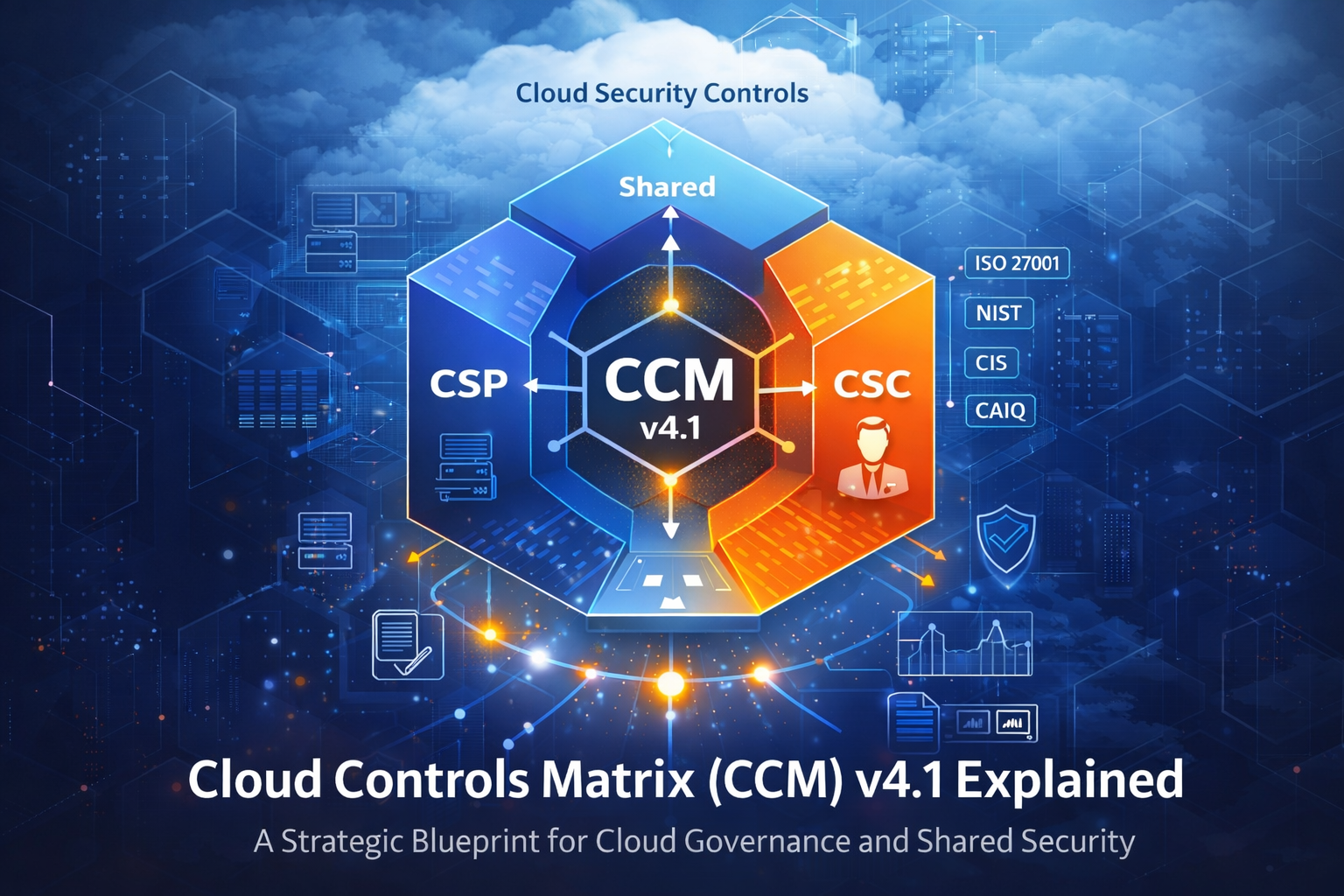
An executive-level analysis of CSA Cloud Controls Matrix (CCM) v4.1 and its strategic impact on cloud governance, shared responsibility, and compliance.
Structured Outline
1. Executive Summary
2. What Is CCM v4.1? From Guidance to Operational Control
3. The Structural Evolution: 207 Controls Across 17 Domains
3.1 Domain Architecture and Coverage
3.2 Why the Structure Matters Strategically
4. The Shared Security Responsibility Model (SSRM): From Ambiguity to Formalization
4.1 CSP-Owned vs CSC-Owned vs Shared
4.2 Independent vs Dependent Shared Controls
5. CCM as a Meta-Framework: Mappings and Regulatory Convergence
6. The CAIQ and the Rise of Structured Transparency
7. Continuous Audit Metrics: The Beginning of Continuous Certification
8. Strategic Implications by Stakeholder Group
8.1 SMBs and Startups
8.2 CISOs and Enterprise Security Leaders
8.3 Government and Public Sector
8.4 Cloud Service Providers
8.5 Auditors and Consultants
9. Operationalizing CCM v4.1: A Maturity Roadmap
10. Critical Evaluation: Strengths, Gaps, and Market Positioning
11. Key Takeaways and Strategic Recommendations
References
Long-Form Article (Approx. 3,250 words)
1. Executive Summary
The Cloud Controls Matrix (CCM) v4.1, published by the Cloud Security Alliance (CSA), represents one of the most mature vendor-neutral cloud security control frameworks available today. According to the official Introductory Guidance to CCM v4.1 (February 2026), CCM v4.1 includes 207 control objectives across 17 domains, enhanced Shared Security Responsibility Model (SSRM) clarity, expanded mappings to global standards, auditing guidelines, and a Continuous Audit Metrics Catalog .
But CCM v4.1 is not merely an update. Strategically, it signals three major shifts in cloud governance:
- From shared responsibility to structured accountability
- From point-in-time certification to continuous assurance
- From fragmented compliance to control convergence
For SMBs, startups, governments, CISOs, CSPs, and auditors alike, CCM v4.1 functions less as a checklist and more as an operating model for secure cloud ecosystems.
2. What Is CCM v4.1? From Guidance to Operational Control
The Cloud Controls Matrix was initially created in 2010 to address the gap between traditional IT risk management and cloud-native architectures. CCM v4.1 now aligns closely with CSA Security Guidance and translates high-level principles into specific, actionable control objectives .
Unlike general information security frameworks, CCM:
- Is cloud-specific by design
- Explicitly defines responsibility boundaries between CSPs and CSCs
- Maps controls to IaaS, PaaS, and SaaS service models
- Connects to other frameworks (ISO 27001, NIST, FedRAMP, etc.)
Strategically, CCM operates as a cloud abstraction layer between governance expectations and cloud technical architectures.
3. The Structural Evolution: 207 Controls Across 17 Domains
3.1 Domain Architecture and Coverage
CCM v4.1 organizes its 207 controls across 17 security domains, including:
- Audit & Assurance
- Application & Interface Security
- Business Continuity & Operational Resilience
- Cryptography & Key Management
- Data Security & Privacy Lifecycle Management
- Identity & Access Management
- Supply Chain Management Transparency
- Threat & Vulnerability Management
- Universal Endpoint Management
…and more .
This breadth ensures coverage from physical datacenter controls to modern API-level vulnerabilities.
3.2 Why the Structure Matters Strategically
The architectural and organizational relevance matrices included in CCM v4.1 are strategically significant. Controls are mapped to:
- Cloud stack components (Physical, Network, Compute, Storage, App, Data)
- Organizational functions (Cybersecurity, Legal, GRC, HR, etc.)
This dual-axis mapping allows:
- Cross-functional accountability
- Better internal audit planning
- Architecture-to-control traceability
- Clear compliance gap analysis
For CISOs, this dramatically reduces translation friction between architecture diagrams and governance documentation.
4. The Shared Security Responsibility Model (SSRM): From Ambiguity to Formalization
4.1 CSP-Owned vs CSC-Owned vs Shared
CCM v4.1 formalizes four ownership categories:
- CSP-Owned
- CSC-Owned
- Shared (Independent)
- Shared (Dependent)
This distinction is not cosmetic. It addresses one of the most persistent cloud risks: misaligned assumptions.
For example:
- Datacenter security is CSP-Owned.
- Data classification is typically CSC-Owned.
- IAM configuration may be Shared (Dependent).
4.2 Independent vs Dependent Shared Controls
The introduction of Shared (Independent) vs Shared (Dependent) controls is one of the most strategic enhancements in v4.1.
- Independent: Both parties implement controls separately.
- Dependent: One party’s implementation depends on the other’s capability provisioning.
Example from the document:
- CSP provides IAM tools.
- CSC must configure permissions correctly .
This distinction directly mitigates cloud breach root causes related to misconfiguration.
5. CCM as a Meta-Framework: Mappings and Regulatory Convergence
CCM v4.1 includes mappings to ISO/IEC 27001/2/17/18, CIS Controls v8, and other frameworks .
This makes CCM a control harmonization engine.
Strategically, this matters because:
- Enterprises face overlapping regulatory regimes.
- Governments require demonstrable alignment.
- CSPs face questionnaire fatigue.
Instead of implementing multiple frameworks separately, organizations can:
- Implement CCM.
- Use mappings to demonstrate alignment.
- Identify partial or full gaps using CCM’s “Gap Level” classification.
For public sector entities subject to frameworks like NIST SP 800-53, CCM functions as a cloud-native overlay.
6. The CAIQ and the Rise of Structured Transparency
The Consensus Assessment Initiative Questionnaire (CAIQ) includes 283 structured questions mapped to CCM controls .
This enables:
- Yes/No/NA standardized responses
- SSRM ownership declaration
- Public transparency via CSA STAR Registry
Strategically, CAIQ:
- Reduces redundant security questionnaires.
- Enables comparative evaluation between CSPs.
- Creates market-level transparency pressure.
For SMBs without large audit teams, CAIQ simplifies vendor due diligence dramatically.
7. Continuous Audit Metrics: The Beginning of Continuous Certification
Perhaps the most forward-looking component is the Continuous Audit Metrics Catalog .
Traditional certifications are point-in-time. Metrics introduce:
- Measurable control performance
- SLA-backed transparency
- Governance maturity tracking
- Potential real-time assurance
This aligns with global regulatory shifts toward continuous monitoring models, as seen in U.S. federal zero-trust initiatives and EU digital resilience regulations.
Strategically, CCM v4.1 positions CSA ahead of static compliance models.
8. Strategic Implications by Stakeholder Group
8.1 SMBs and Startups
For resource-constrained organizations:
- CCM provides a ready-made cloud risk framework.
- CAIQ reduces procurement overhead.
- Mappings prevent duplicate compliance investments.
Recommendation: Adopt CCM as baseline governance and use CAIQ for vendor selection.
8.2 CISOs and Enterprise Security Leaders
For enterprises:
- CCM clarifies responsibility boundaries.
- Enables control traceability across hybrid cloud.
- Aligns security architecture with audit expectations.
Recommendation: Integrate CCM into enterprise GRC platforms and use SSRM matrices in contract negotiation.
8.3 Government and Public Sector
Public entities face:
- Heightened regulatory scrutiny.
- Procurement complexity.
- Interoperability challenges.
CCM’s mapping and structured ownership model reduces ambiguity and supports audit defensibility.
Recommendation: Use CCM in RFP documentation and vendor evaluation criteria.
8.4 Cloud Service Providers (CSPs)
For CSPs:
- CCM demonstrates security maturity.
- Reduces questionnaire burden.
- Enhances STAR registry positioning.
Recommendation: Fully complete CAIQ v4 and publish in STAR Registry for competitive differentiation.
8.5 Auditors and Consultants
Auditors benefit from:
- Auditing Guidelines tailored to each domain.
- Pre-structured assessment criteria.
- Cross-framework traceability.
Consultants can use CCM as benchmarking baseline.
9. Operationalizing CCM v4.1: A Maturity Roadmap
Stage 1: Control Mapping
- Identify applicable controls by service model.
Stage 2: SSRM Clarification
- Assign ownership.
- Validate dependent relationships.
Stage 3: Gap Analysis
- Use mapping matrix to identify regulatory gaps.
Stage 4: CAIQ Alignment
- Standardize documentation.
Stage 5: Metric Integration
- Implement measurable KPIs for key domains (IAM, TVM, Logging).
10. Critical Evaluation: Strengths, Gaps, and Market Positioning
Strengths
- Cloud-native specificity
- Formal SSRM structure
- Continuous audit foundation
- Framework convergence capability
Limitations
- Not prescriptive (intentionally)
- Requires internal customization
- Adoption maturity varies by sector
Market Position
CCM competes conceptually with:
- NIST cloud overlays
- ISO cloud extensions
- Vendor-specific security blueprints
Its advantage lies in vendor neutrality and cross-framework mapping.
11. Key Takeaways and Strategic Recommendations
- CCM v4.1 transforms shared responsibility into shared accountability.
- It enables cloud control convergence across regulatory regimes.
- It anticipates continuous certification models.
- It reduces ambiguity in CSP–CSC relationships.
- It scales from SMBs to governments.
Strategically, CCM v4.1 should not be viewed as a compliance artifact—but as a governance operating system for cloud ecosystems.
Leave a Reply