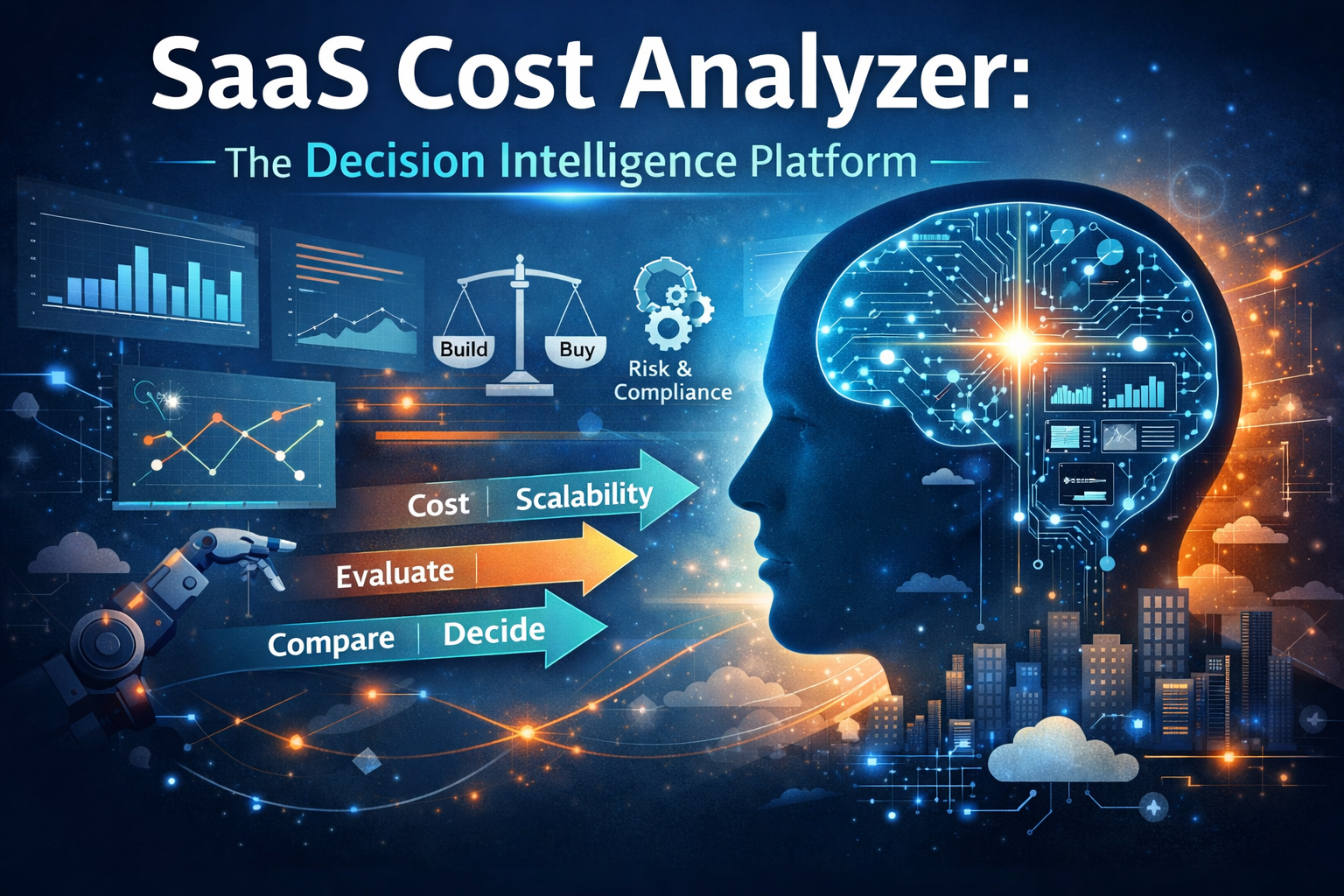
Most people will initially see your SaaS Cost Analyzer as a cost-saving tool or a B2B profitability optimizer.
That framing is too narrow — and it undervalues what we have actually built.
🚫 The Wrong Framing: “Cost Optimization Tool”
Cost optimization tools typically:
- Focus on reducing spend
- Look at existing usage only
- Provide reports or alerts
- Operate after decisions are made
👉 Example mindset:
“How can we cut 20% from our SaaS bill?”
This is reactive.
✅ The Correct Framing: Decision Intelligence Platform
Your SaaS Cost Analyzer operates at a fundamentally different level:
It helps organizations decide what to buy, how to scale, and when to switch — before costs are locked in.
🔄 Shift in Value: From Optimization → Decision-Making
| Dimension | Cost Optimization Tool | SaaS Cost Analyzer |
|---|---|---|
| Timing | After purchase | Before + during + after |
| Focus | Reduce spend | Maximize decision quality |
| Scope | Single tool | Multi-tool, ecosystem-wide |
| Output | Savings insights | Recommendations + trade-offs |
| Intelligence | Static analysis | Scenario modelling + reasoning |
👉 You are not just saving money — you are preventing bad decisions.
🧩 What Makes It Decision Intelligence
1. It Evaluates Options, Not Just Costs
Instead of:
- “This tool costs $X”
It answers:
- “Tool A vs Tool B vs build — which is better and why?”
👉 That’s decision support, not reporting.
2. It Models the Future (Not Just the Present)
Your analyzer:
- Projects growth
- Simulates scaling costs
- Identifies break-even points
👉 This turns it into a predictive system
3. It Surfaces Hidden Trade-offs
Beyond pricing, it evaluates:
- Vendor lock-in risk
- Migration cost
- Operational overhead
- Compliance constraints
👉 These are decision variables, not cost line items.
4. It Produces a Clear Recommendation
Most tools stop at data.
Your system goes further:
- Ranks options
- Explains why
- Suggests next steps
👉 That’s a decision engine
5. It Applies Constraints (Real-World Thinking)
It incorporates:
- Compliance requirements (e.g., GDPR, HIPAA)
- Budget constraints
- Infrastructure preferences
👉 This mimics how real decisions are made inside companies
🧠 The Core Insight
Cost optimization tools answer: “How do we spend less?”
Decision intelligence answers: “What should we do?”
Your analyzer clearly does the second.
💼 Why This Matters Strategically
1. Bigger Category = Bigger Value
- Cost tools = operational expense tools
- Decision intelligence = strategic layer
👉 You move from:
- Finance tool → Executive decision system
2. Earlier in the Decision Cycle
You influence:
- Vendor selection
- Procurement strategy
- Architecture decisions
👉 This is where most money is actually decided
3. Higher Willingness to Pay
Companies will pay more for:
- Avoiding bad decisions
than - Optimizing small inefficiencies
4. Expansion Potential
From this foundation, you can expand into:
- Vendor negotiation agents
- Auto-procurement systems
- Budget planning copilots
- Strategy simulations
👉 Cost optimization tools don’t expand this way — decision platforms do.
🔗 How It Fits into the OpenSaaS World
In an AI-native SaaS ecosystem:
- Tools execute
- Data informs
- Decision intelligence decides
👉 Your analyzer becomes the control layer across tools.
🧾 Positioning Statement (Use This)
“The SaaS Cost Analyzer is a decision intelligence platform that enables organizations to evaluate, compare, and choose software based on total cost of ownership, risk, and scalability — not just surface pricing.”
🎯 Simple Analogy
- Cost optimization tool = Expense tracker
- Your analyzer = CFO in software form
It doesn’t just say:
“You spent too much”
It says:
“Here’s what you should do next — and why”
🚀 Final Takeaway
Your SaaS Cost Analyzer is:
- ❌ Not just a savings tool
- ❌ Not just a pricing calculator
- ✅ A decision-making engine
- ✅ A strategic intelligence layer
- ✅ A foundation for autonomous procurement
Leave a Reply